The Bucharest University of Economic Studies
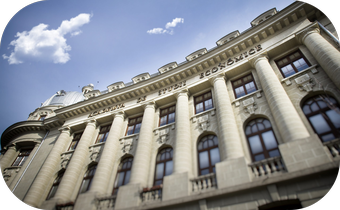
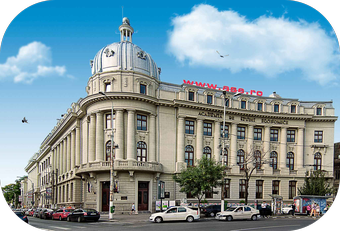
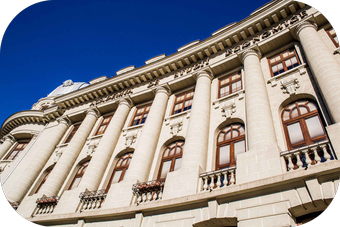
The Bucharest University of Economic Studies (Academia de Studii Economice din București) is Romania’s foremost institution for higher education in economics, business, and public administration, and one of the leading universities of its kind in South-Eastern Europe. Founded in 1913, the University has, for over a century, combined academic rigour with a strong orientation towards the needs of business and society, educating generations of economists, managers, and public administrators who have gone on to shape Romania’s economic and institutional life.
The University is organised into 13 faculties, spanning Business Administration (with instruction in foreign languages), Public Administration and Management, the Bucharest Business School, Business and Tourism, Economic Cybernetics, Statistics and Informatics, Accounting and Management Information Systems, Law, Agri-Food and Environmental Economics, Theoretical and Applied Economics, Finance, Insurance, Banking and Stock Exchange, Management, Marketing, and International Business and Economics.
The University’s standing is reflected in leading international rankings. It is ranked 1st in Romania for the seventh consecutive year and placed in the 801–1000 band worldwide in the Times Higher Education World University Rankings 2026, among 2,191 universities from 115 countries. In the QS World University Rankings by Subject 2025, the University is ranked 351–400 worldwide in Economics & Econometrics — where it remains the national leader — and 501–550 in Business & Management. It is also recognised in the THE World University Rankings for Innovation (WURI), where it ranks 155th among the world’s most innovative universities.
Guided by a longstanding commitment to research, entrepreneurship, and international collaboration, the University maintains an extensive network of academic and institutional partnerships across Europe and beyond, and regularly convenes scholars, practitioners, and policymakers through its programme of conferences and academic events.
The Palace of the Parliament (Casa Poporului), Bucharest
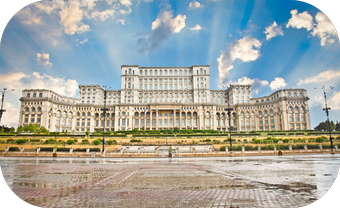
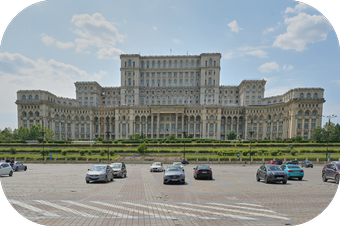
The Palace of the Parliament, known in Romanian as Casa Poporului (the People’s House), is among the most extraordinary architectural monuments of the twentieth century and the seat of the Romanian Parliament, housing both the Chamber of Deputies and the Senate. Built between 1984 and 1989 under the regime of Nicolae Ceaușescu, and designed by architect Anca Petrescu together with a team of several hundred architects, the building stands as one of the defining, if controversial, symbols of Bucharest and of Romania’s twentieth-century history.
Constructed largely from materials sourced within Romania — including vast quantities of Transylvanian marble, crystal, steel, bronze, and wood — the Palace occupies a floor area of some 340,000 m², rising 86 metres above ground with a further 92 metres of subterranean levels, and comprising some 1,100 rooms.
According to Guinness World Records, the Palace of the Parliament holds the following world-leading distinctions:
- The heaviest building in the world, at approximately 4 million tonnes.
- The largest civilian administrative building in the world (surpassed in overall size only by the Pentagon, a military facility).
- The most expensive administrative building in the world.
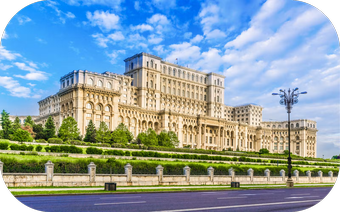
In the immediate vicinity of the Palace stands the Cathedral of the National Salvation (Catedrala Mântuirii Neamului), consecrated in October 2025 to mark the centenary of the Romanian Patriarchate. Rising some 135 metres and comprising a volume of approximately 323,000 m³, the Cathedral is recognised as the largest Orthodox church in the world by volume and by surface area, and holds several further world records, including the largest Orthodox iconostasis and the largest interior mosaic collection in the world. Together, the two monuments — one secular, one spiritual, both raised on an extraordinary scale — form one of the most striking architectural ensembles in Europe.
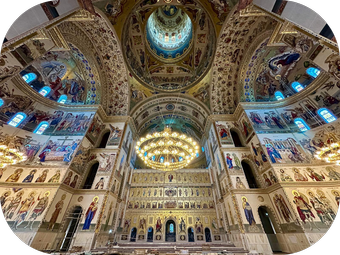
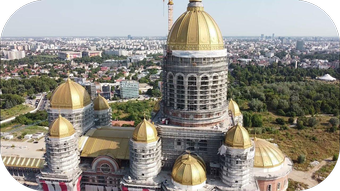
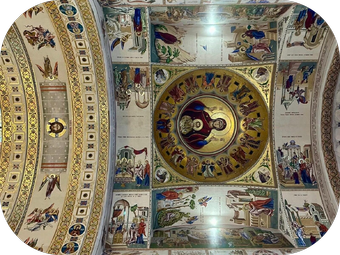
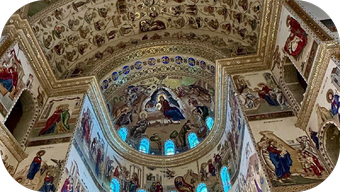
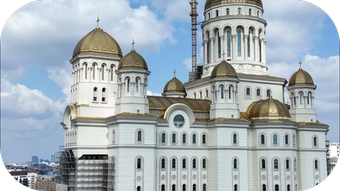
Today, alongside its parliamentary function, the Palace serves as a venue for major national and international conferences, exhibitions, and cultural events, offering an unparalleled architectural setting in the heart of Bucharest.
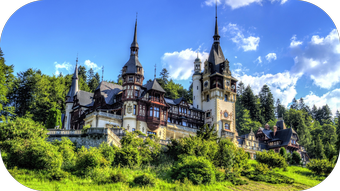
Peleș Castle, Sinaia
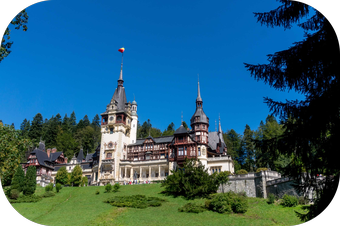
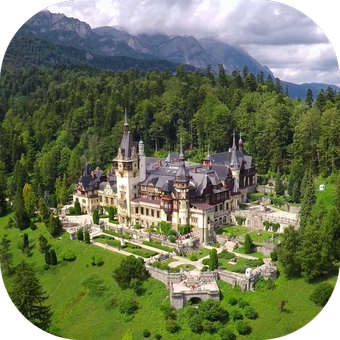
Peleș Castle, nestled in the Carpathian foothills at Sinaia, is widely regarded as one of the finest royal residences in Europe and a defining monument of Romania’s emergence as a modern state. Commissioned by King Carol I, the country’s first monarch, the castle was built between 1873 and 1883, with further additions continuing until 1914, and served as the summer residence of the Romanian royal family until 1947.
Designed in the Neo-Renaissance style, blending German, Flemish Gothic, and Austrian influences, Peleș occupies a 12-hectare park and comprises some 160 rooms, each conceived as a distinct work of art reflecting King Carol I’s travels and cultural interests. The castle was, notably, the first in Europe to be fully powered by its own locally generated electricity, and among the first in the world to feature central heating.
Beyond its architectural and artistic significance, Peleș played a role of genuine historical importance, hosting royal councils and diplomatic gatherings, including the Crown Councils that shaped Romania’s path during the First World War. Today, as the Peleș National Museum, it houses an extensive collection of European art and decorative works, and remains one of the country’s most visited cultural landmarks.
Bran Castle, Transylvania
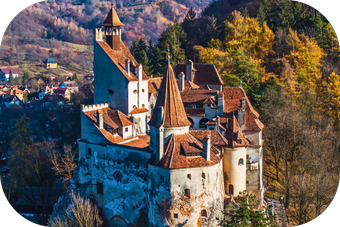
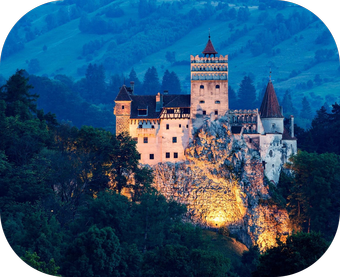
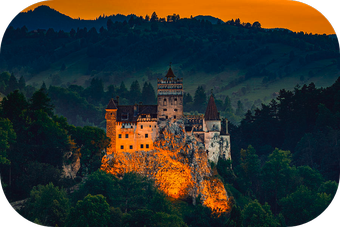
Bran Castle stands on a rocky outcrop in the Bran Gorge, at the historic mountain pass linking Transylvania and Wallachia, some 25 kilometres from Brașov. Built from 1377 by the Transylvanian Saxons under authorisation of King Louis I of Hungary, the fortress was raised to defend the pass against Ottoman incursions and later served as a customs post, guarding one of the principal trade routes between the two Romanian lands.
Over the centuries, the castle passed through the hands of several notable rulers, including Prince Mircea the Old of Wallachia, and its defensive position placed it at the crossroads of the region’s turbulent medieval history. It is closely linked, in popular memory, to Vlad Țepeș (Vlad the Impaler), Prince of Wallachia in the fifteenth century, whose military campaigns brought him through the Bran pass, and who — according to some historical accounts — may have been briefly held there.
Vlad Țepeș’s father, Vlad II — known as Vlad Dracul — was himself Voivode of Wallachia in two separate reigns, from 1436 to 1442 and again from 1443 to 1447. His byname derived from his induction, in 1431, into the Order of the Dragon, a chivalric order established by the Holy Roman Emperor Sigismund of Luxembourg to defend Central and South-Eastern Europe against Ottoman expansion. Ruling from a delicate position between the Kingdom of Hungary and the advancing Ottoman Empire, Vlad Dracul spent part of his youth and reign in Transylvania, and it was in this region — at the citadel of Sighișoara — that his son Vlad III was born in 1431.
In the 1920s, the castle was transformed into a royal residence for Queen Marie of Romania, who oversaw its refurbishment and furnished it as a beloved summer retreat. Today, Bran Castle operates as a museum dedicated chiefly to Queen Marie’s legacy, and remains, owing to its dramatic setting and medieval architecture, one of the most visited castles in Europe.